Pure Philippine Ube
- Composition
- 100% Dioscorea alata. Nothing added — no carrier, no anti-caking agent, no colour, no sugar, no flavour.
- Typical use
- Milled ube powder, retail repacks, single-ingredient supply.
Nearly 75% of global consumers consider a brand’s country of origin as important as or more important than traditional purchasing criteria like price and quality.
Ube is among the most substituted ingredients in the world. Purple sweet potato, taro, imported yam and synthetic colourant are all sold as ube, and nothing on a label tells a buyer which of those they have bought. If you only want the checks, skip to how to verify ube is authentic.
Tatak Ube™ declares two facts on every pack and tests both: that the ube was grown in the Philippines, and how much of it is in the product. It is issued to any buyer or repacker using Philippine Ube Co. ingredients.
Get a Wholesale QuoteVerify a pack
Already sourcing from us? Apply for a Tatak Ube™ license instead.
Ube is Dioscorea alata, a climbing yam grown across the Philippine islands. It is not taro, and it is not purple sweet potato, though both are routinely sold in its place.
Taro is Colocasia esculenta, an aroid from an entirely different plant family. Its flesh is white or faintly lilac-flecked, and its flavour is starchy rather than sweet. Nearly every vividly purple taro product on the market is coloured, because taro is not naturally purple.
Purple sweet potato is Ipomoea batatas, a different genus in a different family again. It is the most common substitute for ube because it is cheaper, grown at far greater scale, and near-identical once dried and milled. A buyer holding two purple powders cannot reliably tell them apart by eye, but we can tell the difference by taste and smell once they are formulated into a finished product.
Philippine ube production is small. National output was 12,483 metric tonnes in 2025, down roughly 14% from 2018, against global demand for anything purple and photogenic. When demand outruns supply the gap gets filled — with cheaper species, with imported yam of the same species grown elsewhere, or with dye.
None of those substitutions is visible in a finished product, and most are not detectable without a laboratory. An ingredient list that reads "ube powder" is not a claim anyone has checked.
Three questions separate a grower-linked supplier from a repackager: what species does the certificate of analysis state, what percentage of the powder is ube solids and what is the rest, and which region and harvest window did the crop come from. A supplier who cannot answer all three in writing is not one you can make an origin claim on behalf of.
Tatak Ube™ exists to make those three answers a condition of putting a mark on a pack. More on how we buy is on our sourcing page.
Five checks, in order. They work on any supplier, whether or not the product carries our mark.
The COA should name the species as Dioscorea alata. Ube, purple sweet potato (Ipomoea batatas) and taro (Colocasia esculenta) are three different plants, and only the first is ube. A COA listing moisture, ash and microbiological counts tells you the powder is safe to eat, not that it is ube.
A powder can be truthfully called ube and still be mostly maltodextrin. Ask for the ube solids percentage and for every other ingredient to be named and quantified. "Ube powder" on an ingredient list is not a number.
Species does not establish country of growth. Dioscorea alata is grown in Vietnam, Indonesia and elsewhere, and the Philippines now imports it. Authentic Philippine ube comes with a named region and harvest window that reconcile to farm delivery records.
Ask for a dye screen showing no synthetic colourant detected. This is the check buyers skip most often, and colour is the signal they trust most — which is precisely backwards, because the most vividly purple products on the market are usually the coloured ones.
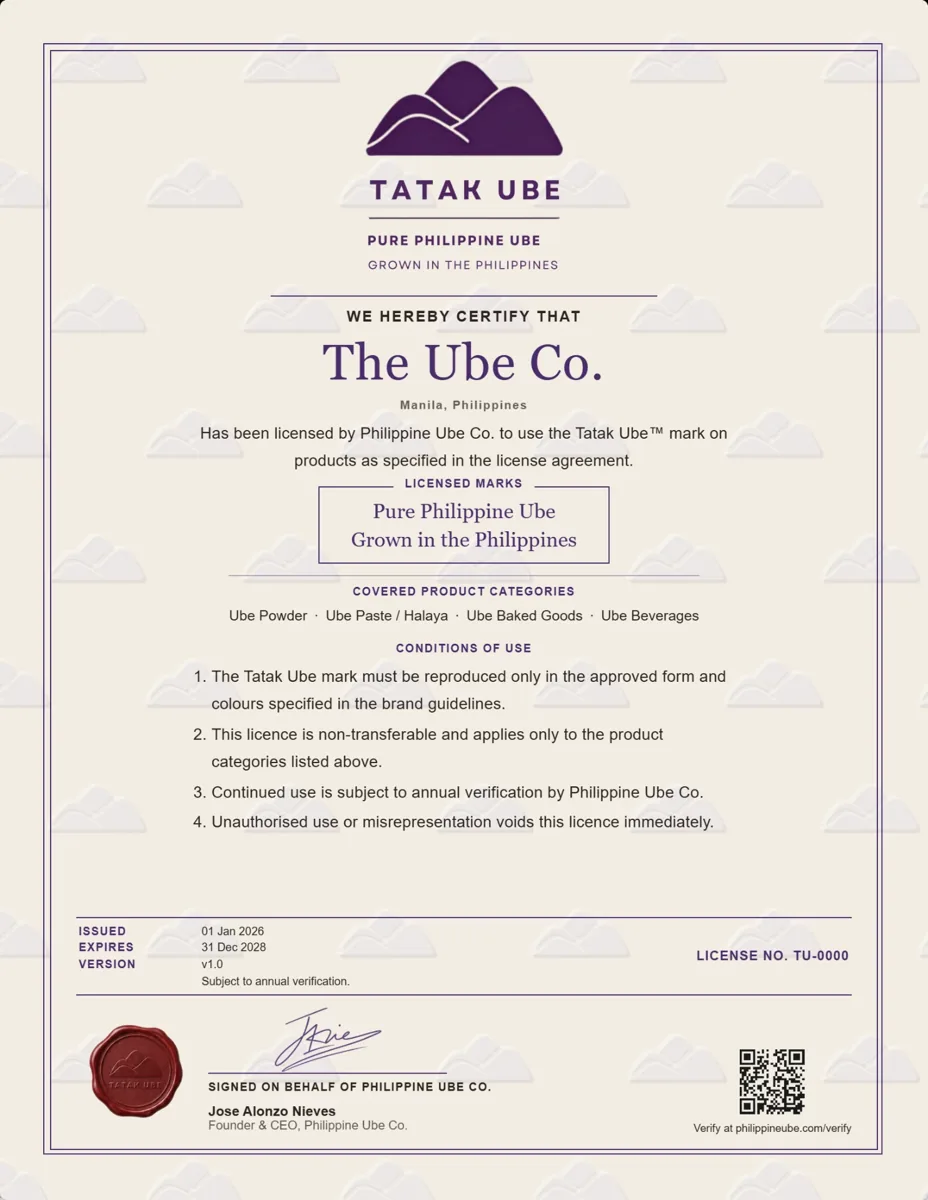
If a pack carries a certification mark, look the license number up rather than trusting the artwork, which anyone can print. Tatak Ube™ licenses are checkable at our public register, which returns the licensee, the tier, the composition and whether the license is current or withdrawn.
If you are still working out which purple ingredient you are actually holding, start with ube vs purple sweet potato vs taro, which covers how the three plants differ. This page is about proving it.
Every gram of ube in the product is Dioscorea alata grown in the Philippines and traceable to a named farm or farming region. No imported yam, no purple sweet potato, no substitution anywhere in the batch.
The tier states whether the product is pure ube powder, a processed ube powder with declared additives, or a product in which ube is not the principal ingredient. Nothing is implied by omission.
Only the tier line changes, so a buyer learns the system once and reads it anywhere.
Apply for a Tatak Ube™ licenseNo license fee. One application per product.
Adjectives are not evidence. Every batch carrying the mark is tested against five factors, and the report travels with the batch.
| Factor | Method | Criterion | What it proves |
|---|---|---|---|
| Species | DNA barcoding — rbcL / matK | Dioscorea alata | Not purple sweet potato, taro or another yam |
| Origin | Documentary chain + mass balance | Reconciled to farm intake | Grown in the Philippines, not blended with import |
| Pigment | HPLC — acylated cyanidin / peonidin | Profile match | Authentic ube pigment, second species check |
| Colourant | Synthetic dye screen | None detected | The colour comes from the crop, not a bottle |
| Content | Saccharide profile / ash / NIR | Matches declaration | The stated ube share is the actual share |
Apply for a Tatak Ube™ licenseLicensed batches carry a test report and a register entry.
Every licensed pack prints a license number. Enter it, with the batch number if shown, to see what the mark is claiming for that product.
Apply for a Tatak Ube™ licenseSelling ube products of your own? Put the mark on your pack.
Any buyer or repacker using Philippine Ube ingredients can apply, per product. There is no license fee. Artwork is supplied and approved before print.
Authentic ube is verified on four documents, not by eye. Ask the supplier for a certificate of analysis naming the species as Dioscorea alata, the ube solids percentage and what the remainder is, the growing region and harvest window, and a synthetic colourant screen. If the pack carries a certification mark, check the license number against that scheme's public register. A supplier who cannot produce all four in writing is not one you can make an origin claim on behalf of.
No. Once dried and milled, ube, purple sweet potato and dyed taro are near-indistinguishable by eye, smell or taste, and they stay indistinguishable once formulated into a finished product. Colour is the least reliable signal of all, because the most vividly purple products on the market are usually the coloured ones. Verification is documentary and laboratory work.
A usable ube COA states the species by its botanical name, the ube solids percentage, the identity and quantity of every other ingredient, the growing region, the harvest window, and the batch number it applies to. It should also record a synthetic dye screen result. A COA that states only moisture, ash and microbiological counts tells you the powder is safe to eat, not that it is ube.
Yes. DNA barcoding against the rbcL and matK regions distinguishes Dioscorea alata from Ipomoea batatas, from taro and from other yams, and it works on dried and milled material. HPLC of the anthocyanin profile is a second, independent check: ube carries a characteristic acylated cyanidin and peonidin signature that purple sweet potato does not match.
A certification claim is only worth what its register says. Ask which scheme issued it, then look the license number up yourself rather than accepting artwork on a pack as proof. Tatak Ube™ licenses are checkable at philippineube.com/tatak-ube/verify, which returns the licensee, the tier, the composition and whether the license is current or withdrawn.
Tatak Ube™ is a certification and provenance mark for products containing Philippine ube. It declares two tested facts: that the ube was grown in the Philippines, and how much of it the product contains. Tatak is the Filipino word for mark or stamp.
Pure Philippine Ube is 100% Dioscorea alata with nothing added. Philippine Ube Blend is a processed ube powder containing 50% or more ube solids, with functional additives named and quantified. Made With Philippine Ube is a product in which ube is present but is not the principal ingredient. The tier names are plain descriptions of what is in the pack, not marks we claim — the mark is Tatak Ube™.
Species is confirmed by DNA barcoding, which distinguishes Dioscorea alata from purple sweet potato and other yams. Country of growth is established through a documentary chain from farm delivery receipt to processing batch record, reconciled by mass balance so no supplier can ship more badged product than their documented Philippine intake supports.
Yes, under the Made With tier, provided every gram of ube in it is Philippine and traceable and no other purple yam, purple sweet potato or synthetic purple colourant is present. The gate is exclusivity, not quantity.
Any buyer or repacker using Philippine Ube Co. ingredients can apply, per product. There is no license fee. Usage is granted per SKU with artwork approved before print, lasts while the licensee continues to buy, and can be withdrawn.
No. Tatak Ube™ is a private mark owned and issued by Philippine Ube Co. It is not affiliated with or endorsed by the Philippine government's Tatak Pinoy programme, and it is not a government certification. Testing is carried out by independent laboratories and batch reports are available to any buyer on request.
Apply for a Tatak Ube™ licenseStill deciding? The application is short and there is no fee.