
Why ube stands out nutritionally
Ube's real nutritional advantage is not borrowed from generic yam tables. It is the pigment chemistry: acylated cyanidin-based anthocyanins (alatanins) that survive heat and pH better than the pigments in most natural purple alternatives. That stability is what makes ube commercially valuable as both a colour and a flavour ingredient.
Highest tropical root anthocyanins
D. alata: 93.32 mg/100g dry weight, 26.6 mg/100g fresh — more than double purple sweet potato and 3.5x taro.
Wins on heat stability
Miyata et al. (2022) found purple yam anthocyanins retained colour better than purple sweet potato and purple potato at 30, 60 and 90°C.
Variety matters more than buyers assume
Cornago et al. (2011) measured total phenolics from 69.9 to 421.8 mg GAE/100g dry across five ube varieties from one source.
Ube nutritional profile per 100g raw, edible portion
| Nutrition Facts | |
|---|---|
| Nutrient | Amount |
| Energy | 97 kcal |
| Carbohydrate | 22.2 g |
| Sugars, total | 0.4 g |
| Dietary Fiber | 3.4 g |
| Protein | 1.7 g |
| Fat | 0.2 g |
| Vitamin C | 6.0 mg |
| Calcium | 19 mg |
| Phosphorus | 44 mg |
| Iron | 0.1 mg |
| Sodium | 7 mg |
| Thiamin (B1) | 0.09 mg |
| Riboflavin (B2) | 0.02 mg |
| Niacin | 0.5 mg |
| Water | 74.9 g |
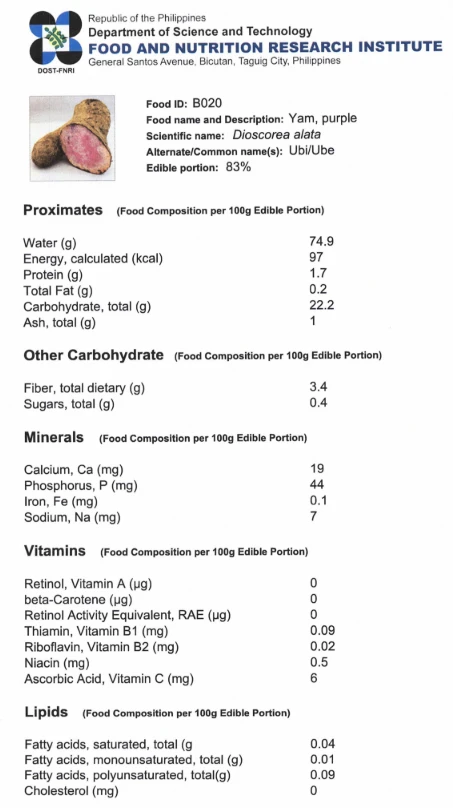
Source: FNRI-DOST, official reply to Philippine Ube Co.'s data request (27 July 2026), Philippine Food Composition Tables, per 100 g edible portion, raw.
Why we removed potassium: The commonly quoted 816 mg potassium figure comes from USDA FoodData Central "Yam, raw" — a generic Dioscorea entry, not D. alata and not Philippine ube. We have not found a published potassium value for Philippine ube, so we do not publish one.
The source document, not just a citation
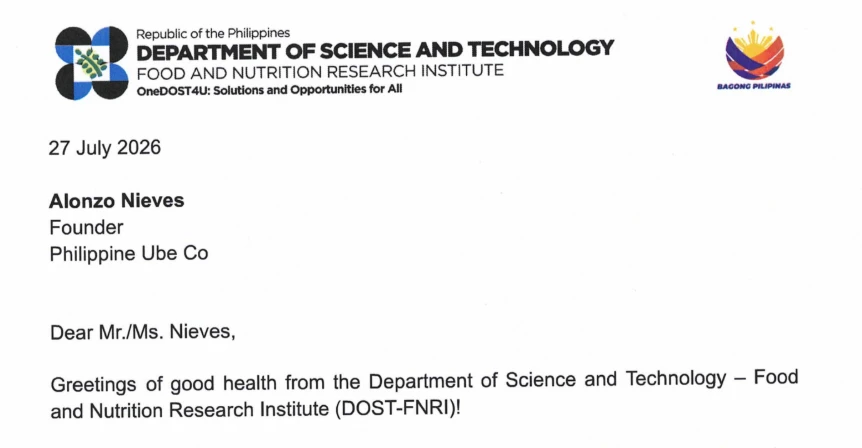
We don't ask you to take "FNRI-DOST" on faith. Here is the actual reply DOST-FNRI sent Philippine Ube Co. on 27 July 2026, and the official Food ID B020 composition table it enclosed for Dioscorea alata ("Yam, purple," Ubi/Ube), the source for every raw-tuber figure on this page.
The science of purple: anthocyanins in ube
Anthocyanins are water-soluble flavonoid pigments responsible for red, purple, and blue colours in plants. In ube, the major anthocyanins are alatanins A, B, and C — cyanidin-based pigments acylated with sinapic acid. The acylated fraction is the majority, not a minority, and it is the reason ube pigments are unusually stable.
Anthocyanin composition in ube
| Anthocyanin | Notes |
|---|---|
| Alatanin A | Diacylated, cyanidin-based with sinapic acid. Contributes most to thermostability. |
| Alatanin B | Diacylated, cyanidin-based. |
| Alatanin C | Monoacylated. Described in 1991 as unusually stable in neutral aqueous solution. |
| Minor cyanidin glycosides | Contribute to colour complexity. |
We do not print percentage proportions because the available figures come from non-Philippine cultivars or single studies and should not be presented as the standard Philippine profile.
How ube compares on anthocyanin content
Always state dry-weight or fresh-weight basis. On a fresh-weight basis, ube is roughly a fifth of blueberries. The stronger, more accurate comparison is against tropical root and tuber crops: ube has the highest anthocyanin content recorded in that group, more than double purple sweet potato and three and a half times taro.
Anthocyanin content, dry weight basis (mg/100g)
Source: Champagne et al. (2011) via Lebot et al. (2022)
Anthocyanin content, fresh weight basis (mg/100g)
Source: Champagne et al. (2011) via Lebot et al. (2022)
Why ube anthocyanins are special: acylation
What sets ube's anthocyanins apart is the degree of acylation. Acylated anthocyanins have aromatic acid molecules attached to their sugar groups, which dramatically improves stability. In ube, the acyl group is sinapic acid, and the resulting alatanins are the most heat-stable natural purple pigments among the major tropical root crops.
Heat stability
Miyata et al. (2022) heated purple yam, purple sweet potato, and purple potato anthocyanins at 30, 60, and 90 degrees Celsius and pH 2.5 and 7.0. Purple yam outperformed the other two crops at every tested temperature and pH.
pH stability
Acylated anthocyanins maintain their purple hue across a wider pH range than non-acylated anthocyanins, which is important for dairy, bakery, and beverage applications.
Long-documented stability
Alatanin C was described by Yoshida et al. (1991) in Tetrahedron Letters as unusually stable in neutral aqueous solution — more than thirty years of documented advantage.
What the research actually shows
Ube's anthocyanins have measured antioxidant activity in laboratory assays. Two Philippine studies quantified it, and purified fractions outperformed BHA and alpha-tocopherol on a per-microgram basis in vitro. These are chemical assays, not clinical outcomes, and no human study has been conducted on ube specifically.
We do not attach cardiovascular, neuroprotective, blood-sugar, or anti-inflammatory health claims to ube because none of those outcomes has been measured in Dioscorea alata. Sticking to what is demonstrated keeps the page accurate and legally defensible.
Why processing method matters
Not all ube products deliver the same colour and aroma. The processing method determines how much of the pigment and volatile character survives.
Fresh, steamed, or minimally cooked
Retains the most anthocyanins and vitamins. Steaming in particular preserves heat-sensitive compounds that boiling can leach away. This is the baseline against which processed forms are measured.
Spray-dried powder (well-controlled)
Ube's anthocyanins are acylated and unusually stable, and modern spray-drying is fast enough that evaporative cooling keeps the product below the inlet air temperature. Our spray-dried powder retains most of the colour and antioxidant content; we do not claim this as a published finding, but as our own process observation. Older high-heat drum drying degrades more.
Ube halaya (jam)
Prolonged cooking at 100 degrees C+ reduces anthocyanin content significantly. The sugar and fat added during halaya preparation also change the overall nutritional profile substantially.
For a detailed comparison of ube product forms, see our guide on ube powder vs extract vs flavoring.
Food industry applications: natural purple colorant
The food industry is actively seeking natural alternatives to synthetic colorants. Ube anthocyanins offer a compelling alternative with three distinct advantages:
Clean label
Ube powder can be listed simply as 'ube powder' or 'purple yam' on ingredient labels, avoiding numbered synthetic colorant declarations that consumers increasingly avoid.
Dual function
Unlike isolated colorant extracts, ube powder provides both colour and flavour, a two-in-one ingredient that simplifies formulation.
Stability advantage
Acylated ube anthocyanins offer better processing stability than elderberry, butterfly pea flower, or red cabbage as natural purple sources.
Related reading
- What cooking actually does to ube: fresh vs. boiled, by the numbers — the same DOST-FNRI dataset, comparing the boiled entry against the raw figures above.
- Why ube isn't purple all the way through: the genetics behind the color — published research on why flesh color varies within a single tuber.
Data Sources
- [1]FNRI-DOST (2026): Food and Nutrition Research Institute, Philippines. Official reply to Philippine Ube Co.'s direct data request, 27 July 2026, citing the Philippine Food Composition Tables (PhilFCT) online database. Per 100 g edible portion, raw.View source
- [2]Lubag et al. (2008): Lubag, A.J.M. Jr., Laurena, A.C. & Tecson-Mendoza, E.M. Philippine Journal of Science 137(1): 61–67.
- [3]Yoshida et al. (1991): Yoshida, K., Kondo, T. & Goto, T. 'Alatanin C, a stable anthocyanin from Dioscorea alata.' Tetrahedron Letters 32(40): 5579–5580.
- [4]Giusti & Wrolstad (2003): Giusti, M.M. & Wrolstad, R.E. 'Acylated anthocyanins: stability and color.' Biochemical Engineering Journal 14(3): 217–225.
- [5]Lebot et al. (2022): Lebot, V., Lawac, F. & Legendre, L. Journal of Food Composition and Analysis. Anthocyanin table adapted from Champagne et al. (2011).
- [6]Miyata et al. (2022): Miyata, R., Sano, H., Hoshino, S. & Kumazawa, S. 'Thermal stability of anthocyanins from purple yam, purple sweet potato, and purple potato.' Bioscience, Biotechnology, and Biochemistry 86(7): 916–921. DOI 10.1093/bbb/zbac060.
- [7]Cornago et al. (2011): Cornago, D.F., Rumbaoa, R.G.O. & Geronimo, I.M. 'Total phenolic and flavonoid contents of selected Philippine ube (Dioscorea alata) varieties.' Philippine Journal of Science 140(2): 145–152.