The Philippines Has a National Standard for Ube Halaya. Its Own Data Says None Gets Made.
PNS/FDA 24:2010 sets the official spec for Purple Yam (Ube) Jam. PSA's own supply and utilization accounts record zero tonnes of ube processing every year from 1990 to 2022.
By Philippine Ube
Two government documents describe the same industry and appear to contradict each other. Neither one is wrong, and that's the part worth sitting with.
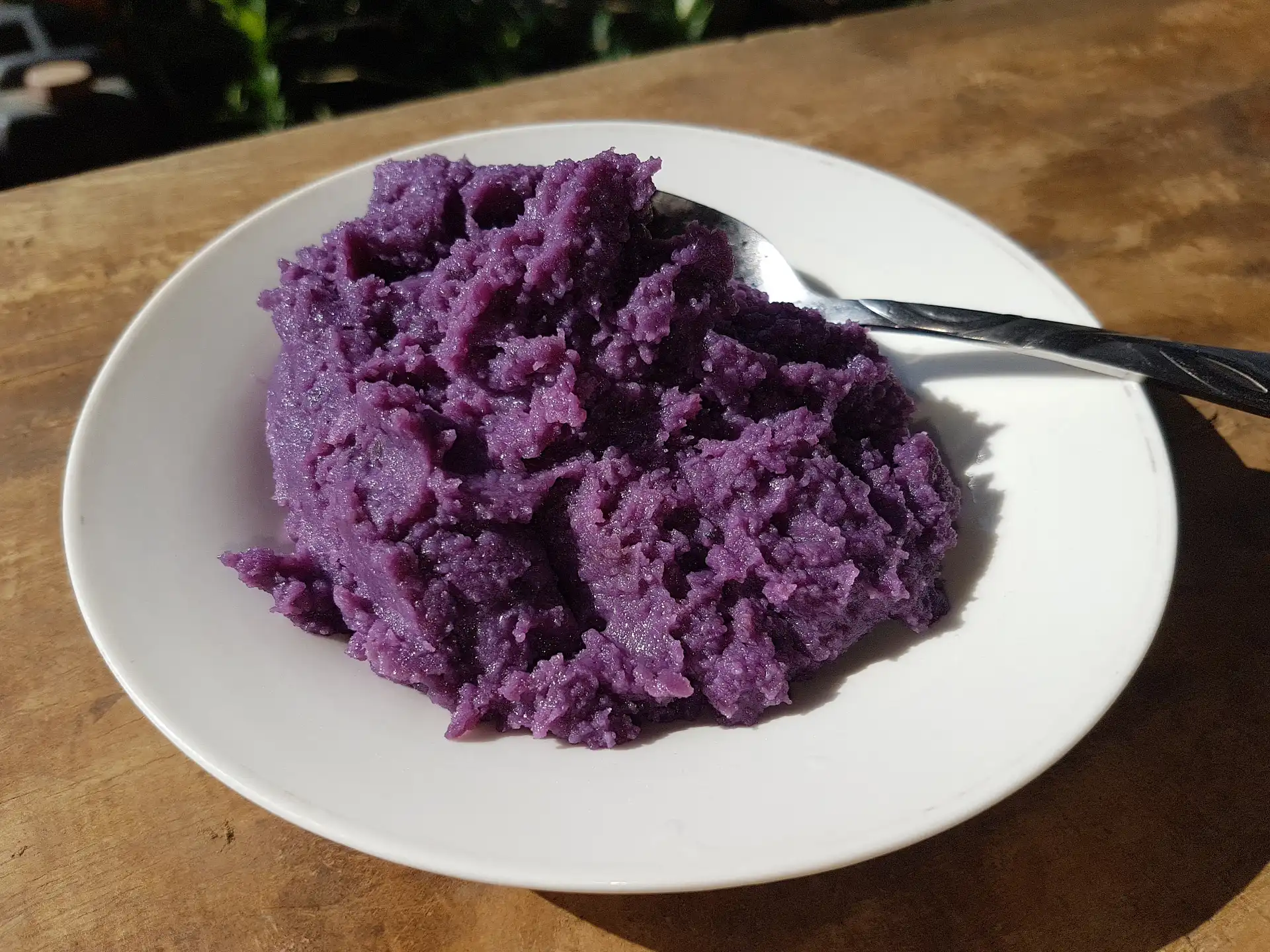
The first is PNS/FDA 24:2010, the Philippine National Standard for Purple Yam (Ube) Jam (Halaya). It is a real, detailed food-safety specification: pH and water-activity thresholds, commercial sterility testing methods drawn from Codex Alimentarius, AOAC and USFDA procedures, defect tolerances, the works. A government agency does not write a standard like this for a product that does not exist. Halaya is real, it is sold everywhere in the Philippines, and the state took the trouble to regulate how it is made.
The second is the Philippine Statistics Authority's Supply and Utilization Accounts for root crops, which break down what happens to every tonne of ube produced nationally: how much goes to food, feed and waste, seed, exports, and processing. The processing column reads zero tonnes for every single year from 1990 to 2022. Thirty-three consecutive years. Not a small number rounded down. Zero.
Why both can be true at once
The contradiction isn't that one document is fake. It's that they're measuring different things, and the measurement gap is the actual story. PSA's Supply and Utilization Accounts are a residual calculation: producers report harvested volume, and known-quantity uses (a fixed 4.00% feeds-and-waste coefficient, a similar fixed seed coefficient, recorded exports) get subtracted out. What's left over is meant to represent food use and processing combined, split by a formula. For ube, that formula has apparently never been built to detect processing as its own category, so it defaults to zero every year regardless of how much halaya, ice cream base, or bakery filling actually gets made from purple yam that year.
In other words: this isn't evidence that no one processes ube. It's evidence that the accounting system was never built to see it happen. A country can have a national safety standard for a product and, simultaneously, an official statistics table with no way to record that the product exists. Those aren't opposing facts. They're two different arms of government working from two different tools, neither one talking to the other.
Why this actually matters, beyond being a weird footnote
If official statistics show zero processing every year, any policy decision built on those numbers, investment cases, export promotion budgets, R&D funding priorities, is working from a blind spot exactly where a growing, exportable, value-added ube industry would show up. The Philippines' own farmgate and production data already shows a crop under real pressure: falling area, volatile pricing, uneven regional reporting. Add an accounting gap that erases processing entirely, and the picture policymakers are working from understates the industry that already exists, not just the one that could exist with better support.
This is not a story about anyone getting it wrong on purpose. The FDA standard-writers and the PSA statisticians work in different agencies, building different tools for different purposes, and nobody's job description includes reconciling the two. That's a gap in the system, not a villain in it.
What we'd want to see instead
Ube processing is measurable. Halaya producers, ice cream manufacturers using ube base, and bakeries buying ube filling all exist as real, contactable businesses. A dedicated processing-volume survey, even a modest one, would replace an admittedly-fictional zero with a real number, and it would strengthen the case for exactly the kind of investment the industry needs. Until then, "zero tonnes of processing" is a fact about how the number is built, not a fact about the Philippine ube industry.
We source directly from farm partners and keep our own volume and processing records because of gaps like this one. If you're formulating with ube and need supply-side context you can actually trace, get in touch.
Frequently Asked Questions
Does the Philippines have an official standard for ube halaya?
Yes. PNS/FDA 24:2010, Purple Yam (Ube) Jam (Halaya) - Specification, is a Philippine National Standard issued by the FDA covering composition, quality factors, food additives, hygiene, and testing methods including pH, water activity, and commercial sterility.
Do Philippine government statistics really show zero ube processing?
Yes, for every year from 1990 to 2022, according to PSA's Supply and Utilization Accounts for root crops. This reflects how the accounting formula is built, a residual calculation that has apparently never been designed to detect processing as its own category, not an assertion that no halaya, ice cream base, or bakery filling is actually made from ube.
Is ube halaya actually made and sold in the Philippines?
Yes, widely. It's one of the most common ube products in the country, sold in markets, bakeries, and used in numerous desserts. The zero figure in PSA's accounts is a measurement gap, not evidence to the contrary.
Why would official statistics miss an entire product category?
Supply and Utilization Accounts are built as a residual calculation: known uses (feeds, waste, seed, exports) are subtracted from total production, using fixed percentage coefficients in some categories, and what remains is split between food and processing by a formula. For ube, that formula appears to default processing to zero every year, regardless of actual volume, because the system was never built with a direct way to measure it.