Why Ube Isn't Purple All the Way Through: The Genetics Behind the Color
Published research on 70 ube accessions shows flesh color is often uneven within a single tuber, and it's genetic, not a defect
By Philippine Ube
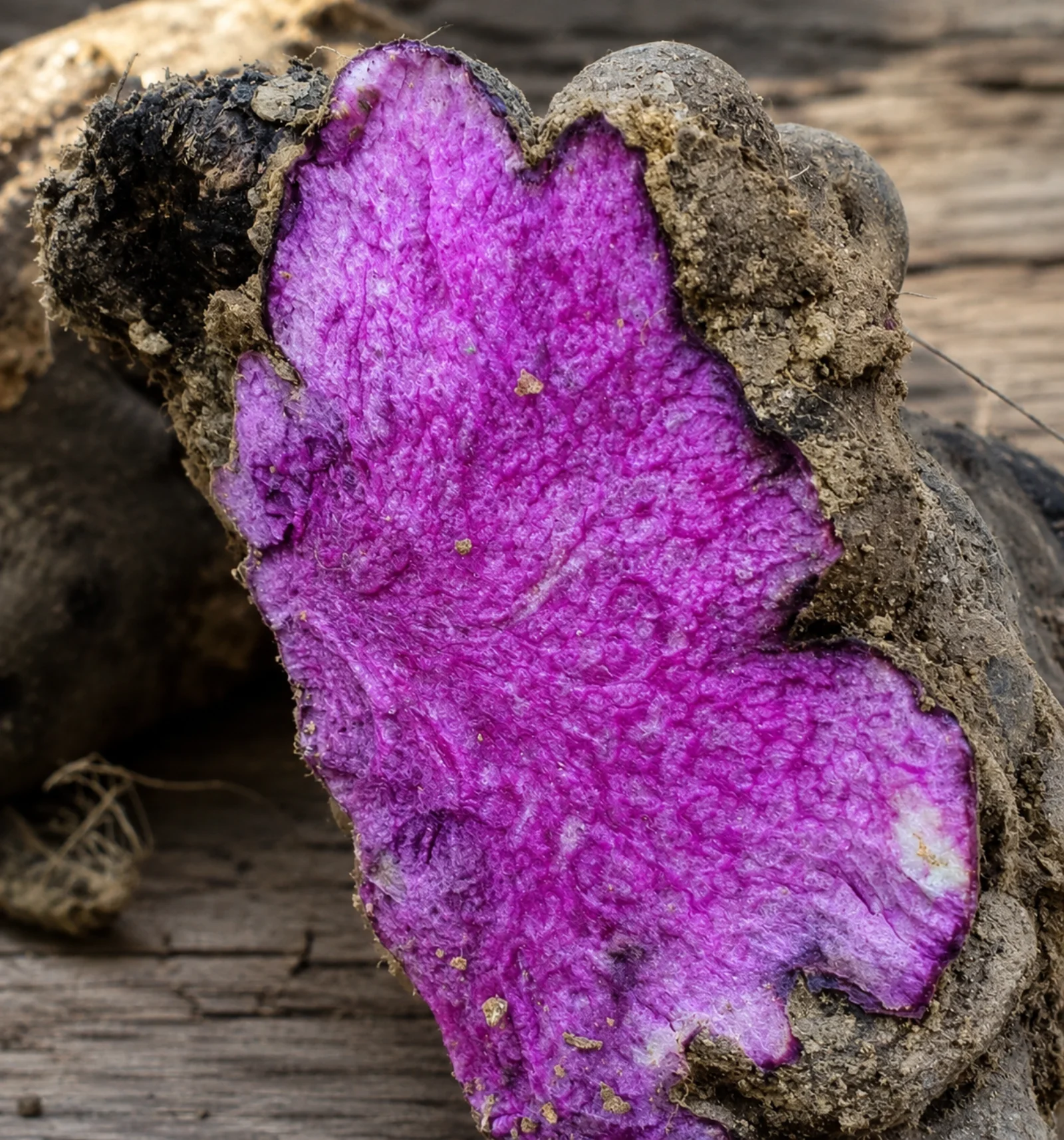
Cut open a few ube tubers from the same batch and you will notice the purple is not identical from one to the next, and it is often not even uniform within a single tuber. One end reads deep violet, the other trails off toward pale lavender or white. Buyers who expect a flat, consistent color sometimes read this as a quality problem. Published research on Philippine ube says otherwise: it is ordinary genetic variation, and it shows up even inside one tuber.
The study: 70 accessions, one common garden
Ferriol (2023), published in the Romblon State University Research Journal, collected 70 yam accessions from nine municipalities across Tablas Island and grew them together in a single common-garden plot, the standard method for separating genetic variation from growing-condition variation. Flesh color was scored separately at three points on each tuber: the head, the central cross-section, and the lower part.
The result: only 64.3% of accessions showed uniform flesh color across their own cross-section. Purple at the tuber's head appeared in 42.9% of accessions, purple at the central cross-section in 27.1%, and purple at the lower part in 25.7%. Purple stem coloration, a different trait scored separately, showed up in 71.5% of accessions.
In plain terms: for more than a third of the tubers studied, the amount and intensity of purple genuinely changed from one end of the tuber to the other. This was not measurement noise. It was scored deliberately, at three separate points, because the researchers expected it to vary.
Why this happens: color is a genotype trait, not a place effect
The broader phytochemical literature on Dioscorea alata backs this up from a different angle. A 2022 review in the Journal of Food Composition and Analysis reports that purple flesh coloration is controlled by anthocyanin-pathway genes, and specifically that transcriptome studies have found several of those genes significantly upregulated in purple-fleshed cultivars compared to white ones. Pigment intensity and distribution is a heritable trait expressed through the plant's own biosynthesis pathway, not something imposed by soil or climate.
That helps explain why pigment distribution can be uneven within one tuber. Anthocyanin synthesis is not automatically identical across every cell of a growing tuber. Where the pathway is expressed most strongly, the color deepens; where it is expressed less, it lightens toward white. The same genetic instruction can play out differently across the head, middle, and base of a single root as it develops.
What this means if you are buying or cooking ube
A few practical takeaways follow directly from the research:
- An unevenly colored tuber is not necessarily a defect. Uneven flesh color within a single tuber is a documented, common trait, not a sign of poor handling or spoilage.
- Uniform, saturated purple across every single batch is the thing worth questioning. Natural ube varies by cultivar and, per this research, sometimes within one tuber. A supplier whose product is identically purple in every piece, every time, is more likely relying on added color than on the tuber alone. We cover this checking method in more depth in our piece on how to check what you are buying.
- Color intensity is a real quality signal, just not a simple one. Deeper, more consistent purple in a given cultivar does correlate with higher measured anthocyanin content, which is why we track color depth by variety on our ube varieties guide. It just is not a guarantee that every tuber of that variety will look identical top to bottom.
The caveat worth stating plainly
Ferriol's study is a real peer-reviewed paper with standardized descriptors, but it is a single-author study in a regional university journal, without a DOI, and its own body text contains a few transcription errors (its tables are more reliable than its prose, and the figures above come from the tables). It is solid, specific, citable evidence, not the final word on the subject. We would rather tell you exactly how strong the source is than round it up.
If you are sourcing ube for a product where color consistency matters, talk to us about variety-specific grading rather than assuming any single number describes every tuber you will receive.
Frequently Asked Questions
Why is my ube tuber not purple all the way through?
This is normal and well documented. A study of 70 Philippine ube accessions (Ferriol, 2023) found that only 64.3% showed uniform flesh color across their own cross-section, with purple concentration varying between the head, center, and base of the same tuber. Uneven internal color is a genetic trait, not a sign of poor quality or improper storage.
Is white ube flesh a sign of a fake or bad tuber?
No. Some Dioscorea alata cultivars are naturally white or pale-fleshed, and even purple cultivars can show lighter or white sections within an individual tuber. Research has found that some white-fleshed ube cultivars actually score higher on certain antioxidant measures than purple ones, so white flesh on its own says nothing about quality.
Is ube's purple color caused by where it's grown?
The evidence points to genetics, not location. Anthocyanin-pathway genes are measurably upregulated in purple-fleshed ube cultivars compared to white ones, which is a genotype effect. Growing conditions can influence overall plant health, but the published chemistry literature treats pigment expression as primarily a heritable trait rather than a soil or climate effect.
Should I be suspicious of ube powder that is perfectly uniform purple in every batch?
It is worth asking questions. Natural ube shows real variation in color, both between tubers and sometimes within a single tuber, tied to cultivar and genetics. A product that is identically saturated purple in every batch, with no natural variation at all, is more consistent with added color than with unmodified ube.